Accordian Closable

China Top 10 Robotics and Automation Manufacturers?

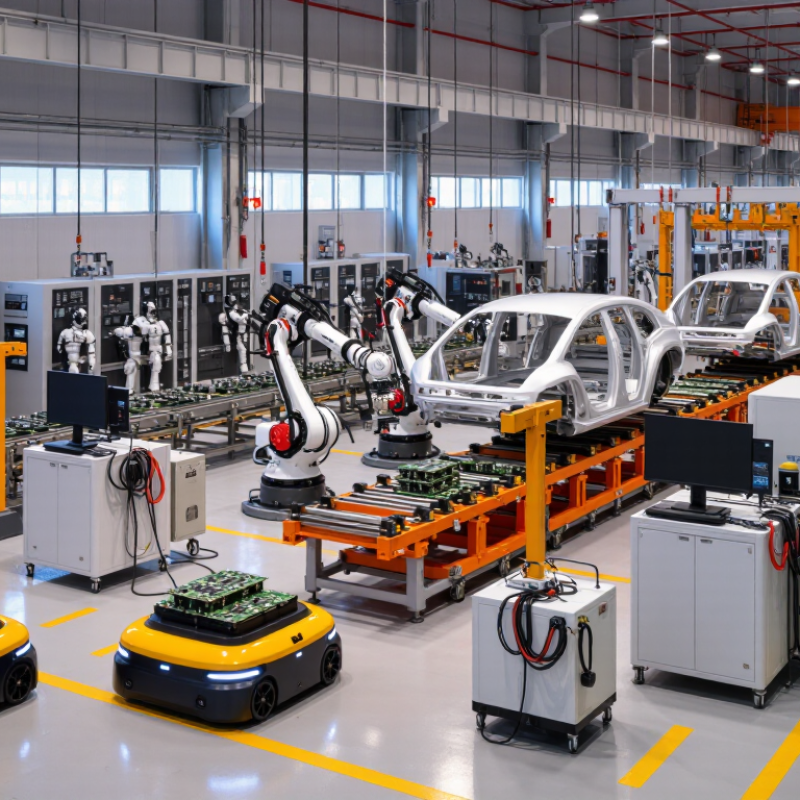
China has become a central force in global robotics and automation. Its factories now resemble connected ecosystems, where robotic arms weld vehicle frames, guided vehicles move components, and vision systems inspect tiny defects.

The International Federation of Robotics reported in World Robotics 2024 that China installed 276,288 industrial robots in 2023. That represented approximately 51% of global installations. China also reached a robot density of 470 units per 10,000 manufacturing employees, according to the same report. These figures show scale, but they do not tell the whole story. Supplier quality, software capability, service coverage, and system integration remain equally important.

This guide examines ten leading Chinese manufacturers across industrial robots, collaborative robots, mobile platforms, and automation systems. The selection considers market presence, technical development, production experience, customer industries, and publicly available company information. It also reflects priorities outlined by China’s Ministry of Industry and Information Technology, including intelligent manufacturing, core component development, and wider industrial adoption.

No ranking is permanent.

Some companies excel in automotive production. Others focus on electronics, warehouses, welding, or flexible assembly lines. Their strengths can change as patents, partnerships, export performance, and after-sales networks develop. Industry data also has limits, because private-company disclosures are sometimes incomplete. Readers should therefore treat this list as a practical market overview, not an absolute verdict. A careful buyer still needs independent testing, safety evaluation, integration analysis, and lifecycle-cost review before choosing a supplier.
China Top 10 Robotics and Automation Manufacturers?

Definition and Scope of China’s Robotics and Automation Industry

China Top 10 Robotics and Automation Manufacturers?

Definition and Scope of China’s Robotics and Automation Industry

China’s robotics and automation industry covers more than robot arms. It includes industrial robots, mobile robots, machine vision, control systems, sensors, software, and system integration. Service robots also belong to this scope when they support logistics, healthcare, cleaning, or inspection. The boundary remains imperfect because automation equipment often overlaps with smart manufacturing and industrial software.

The International Federation of Robotics reported 276,288 industrial robot installations in China during 2023. This represented about 51% of global installations. Its World Robotics 2024 report also recorded approximately 470 robots per 10,000 manufacturing employees in China. These figures show market scale, but they do not prove equal technical strength across every segment. The China Robot Industry Alliance estimated China’s robot market at more than 170 billion yuan in 2023, including industrial and service applications. Different reports use different definitions, so comparisons require care.

Tips: When assessing the top ten manufacturers, examine shipment volume, domestic production, patented technologies, software capability, reliability, and after-sales support. A factory visit can reveal practical weaknesses that brochures hide. Check integration results, maintenance records, and production-line stability. Ranking only by revenue can be misleading. Some smaller suppliers may deliver stronger results in specialized environments, while large suppliers may depend heavily on external components.

Criteria for Ranking China’s Leading Robotics Manufacturers

China Top 10 Robotics and Automation Manufacturers?

Ranking China’s leading robotics manufacturers requires more than counting patents or showcasing polished factory videos. A credible assessment should examine verified installations, engineering depth, product reliability, and customer support. Factory visits can reveal practical details, such as cable protection, calibration areas, spare-parts storage, and operator training spaces. These details often matter more than impressive demonstrations.

Performance should receive measurable weight. Useful indicators include cycle-time consistency, positioning accuracy, uptime, energy consumption, and failure rates across different production environments. Safety certification and compliance with international standards also deserve close review. A strong manufacturer should explain risk controls clearly, provide traceable testing records, and support safe integration with existing equipment. Service response time matters, especially when a production line stops unexpectedly.

The ranking should also consider software capability, system compatibility, delivery discipline, and long-term maintenance costs. Independent customer references are valuable, but they need careful verification. A large installation does not always prove superior engineering. No scorecard is perfect. Market data may be incomplete, and customer feedback can be selective. Smaller manufacturers may also lack public documentation while delivering excellent technical results. For that reason, transparent scoring, repeated evidence, and honest disclosure of limitations should guide the final top-ten selection.

Overview of China’s Top 10 Robotics and Automation Manufacturers

China’s top 10 robotics and automation manufacturers reflect a broad industrial ecosystem, not one single technology. The group includes suppliers of industrial arms, collaborative robots, mobile robots, machine vision, control systems, and factory software. Their equipment appears on welding lines, battery plants, electronics workshops, and warehouse floors. A typical installation may combine a six-axis arm, a vision camera, safety sensors, and a programmable controller.

The International Federation of Robotics reported 276,288 industrial robot installations in China during 2023, representing about 51% of global demand. China also reached approximately 470 robots per 10,000 manufacturing employees, according to World Robotics 2024. These figures explain why domestic manufacturers are competing on cycle time, integration speed, and after-sales service. China Robot Industry Alliance reports continued growth in the country’s robot industry, especially across new energy, logistics, and electronics. However, a top-ten ranking remains imperfect. Public data often combines robot sales, system integration, and software revenue. Smaller specialists may therefore be underestimated. Buyers should inspect repeatability, maintenance records, spare-parts access, and real production results, rather than trust market visibility alone. The best system is not always the fastest. It is the one that keeps a camera calibrated and a production line moving.

China Top 10 Robotics and Automation Manufacturers? - Overview of China’s Top 10 Robotics and Automation Manufacturers

Comparative overview based on publicly documented product capabilities, application coverage, manufacturing experience, and market presence. Company names and brand identifiers are intentionally omitted.
Rank Manufacturer Profile Primary Robotics Focus Typical Robot Types Main Industries Served Automation Scope Export and Project Coverage
1 Profile A Industrial robots and complete production-line integration Articulated, SCARA, delta, and palletizing robots Automotive, electronics, metalworking, and logistics Robot hardware, controllers, end effectors, vision, and turnkey cells Domestic projects with established overseas deliveries and system-integration work
2 Profile B High-performance motion control and industrial robot platforms Six-axis, SCARA, collaborative, and parallel robots 3C electronics, batteries, semiconductors, and consumer goods Robot arms, servo systems, control software, vision, and smart workstations Strong suitability for high-volume manufacturing and international OEM projects
3 Profile C Collaborative robotics and flexible automation Collaborative arms, compact six-axis robots, and mobile platforms Small and medium-sized manufacturing, assembly, inspection, and packaging Easy programming, force sensing, machine tending, and rapid deployment Suitable for modular projects and distributors serving multiple regions
4 Profile D Welding, cutting, and heavy-duty robotic automation Welding robots, gantry systems, heavy-payload articulated robots Construction machinery, steel fabrication, automotive components, and shipbuilding Arc welding, laser processing, handling, positioners, and safety systems Primarily project-based, with capabilities for large factories and overseas installations
5 Profile E SCARA and precision assembly automation SCARA, delta, desktop, and compact Cartesian robots Electronics, medical devices, connectors, and precision components Pick-and-place, dispensing, screwdriving, testing, and visual inspection Well suited to clean, repetitive, high-speed production environments
6 Profile F Mobile robotics and warehouse automation Autonomous mobile robots, automated guided vehicles, and sorting systems Warehousing, e-commerce, manufacturing logistics, and retail distribution Transport, picking, sorting, storage, fleet management, and warehouse software Scalable deployments for domestic facilities and selected international logistics projects
7 Profile G Packaging, palletizing, and food-processing automation Delta, palletizing, case-packing, and articulated robots Food and beverage, pharmaceuticals, chemicals, and consumer products Packing, labeling, palletizing, weighing, inspection, and hygienic handling Commonly delivered through integrators for production and distribution facilities
8 Profile H Machine vision and intelligent inspection systems Vision-guided robots, inspection cells, and precision positioning systems Electronics, automotive parts, batteries, packaging, and pharmaceuticals Defect detection, measurement, traceability, sorting, and robot guidance Applicable to both standalone inspection equipment and integrated production lines
9 Profile I Educational, service, and specialized robotic systems Service robots, training platforms, delivery robots, and custom prototypes Education, healthcare support, hospitality, public facilities, and research Navigation, human-machine interaction, remote monitoring, and pilot deployments Often supplied through demonstration programs, research partnerships, and specialized projects
10 Profile J Custom automation equipment and integrated smart factories Custom robotic cells, Cartesian systems, handling robots, and integrated lines New-energy equipment, machinery, appliances, electronics, and general manufacturing Engineering design, controls, MES connectivity, material handling, and production optimization Flexible project delivery with strong emphasis on application-specific customization

Key Products, Technologies, and Industry Applications

China’s top ten robotics and automation manufacturers cover industrial robots, collaborative arms, mobile platforms, and smart production systems. Their key products include six-axis robots, palletizing units, welding cells, machine-tending equipment, and automated guided vehicles. These systems serve automotive, electronics, metalworking, logistics, food processing, and pharmaceutical packaging facilities.

Core technologies now include machine vision, force sensing, digital twins, and artificial intelligence for quality inspection. High-speed controllers coordinate robots with conveyors, sensors, and programmable equipment. Vision cameras can detect missing screws or uneven seals within seconds. Force sensors help collaborative arms handle fragile components without excessive pressure. In logistics centers, mobile robots map aisles, avoid obstacles, and deliver bins to workstations.

Field performance depends on more than specifications. Factory teams must check cycle time, payload stability, safety separation, software compatibility, and maintenance access. The floor matters. Uneven surfaces can reduce navigation accuracy. Poor lighting may confuse vision systems. That gap hurts. Some systems also require skilled technicians, which smaller factories may lack. Real deployment should include spare-part planning, operator training, and a measured pilot line. Energy use, noise, and recovery after network failures deserve attention too. A robot may look precise in a demonstration, yet production dust, changing materials, and rushed operators can expose weaknesses.

Market Comparison and Future Development Trends

China’s top ten robotics manufacturers should be compared beyond shipment volume. Product reliability, motion accuracy, software integration, and service coverage matter more in daily factories. The International Federation of Robotics reported 276,288 industrial robots installed in China during 2023. That represented about 51% of global installations, despite a year-on-year decline. The market is large, but not effortless.

Domestic manufacturers held approximately 47% of China’s industrial robot installations in 2023, according to World Robotics 2024. This suggests stronger local competition and faster adaptation to Chinese production needs. However, market share does not prove long-term quality. Some suppliers perform well in automotive lines, while others serve electronics, warehousing, or small workshops. Service response can differ sharply between coastal cities and inland plants. That weakness deserves attention.

Future growth will depend on intelligent control, machine vision, collaborative systems, and energy efficiency. China’s robot density reached 470 units per 10,000 manufacturing employees in 2023, according to the International Federation of Robotics. The number shows progress, but it also raises a practical question: are factories using robots effectively? Interact Analysis expects continued expansion in industrial robotics, although slower economic growth may delay capital spending. Manufacturers that combine affordable hardware, reliable software, skilled technicians, and lifecycle support will likely gain an advantage. The ranking remains imperfect. Public data rarely measures downtime honestly.