2026 How to Choose the Best Automated Welding Robot for Your Business
In the ever-evolving world of manufacturing, choosing the right automated welding robot can be a daunting task. David Adams, an industry expert in robotic automation, once stated, “The success of your welding process hinges on selecting the right robotic technology.” This highlights the importance of making an informed choice.
Automated welding robots come in various sizes and capabilities. Each model caters to specific needs, whether it's for mass production or custom projects. Ignoring these details can lead to subpar results. For example, choosing an inadequate robot could affect quality and efficiency, ultimately impacting your bottom line.
It's essential to consider factors like your production volume, workspace, and welding techniques. Many businesses overlook these aspects, resulting in regrets down the line. Evaluating workflows and understanding equipment limitations aids in making a wise decision. An informed choice in an automated welding robot can elevate your operations.
Understanding the Fundamentals of Automated Welding Robots
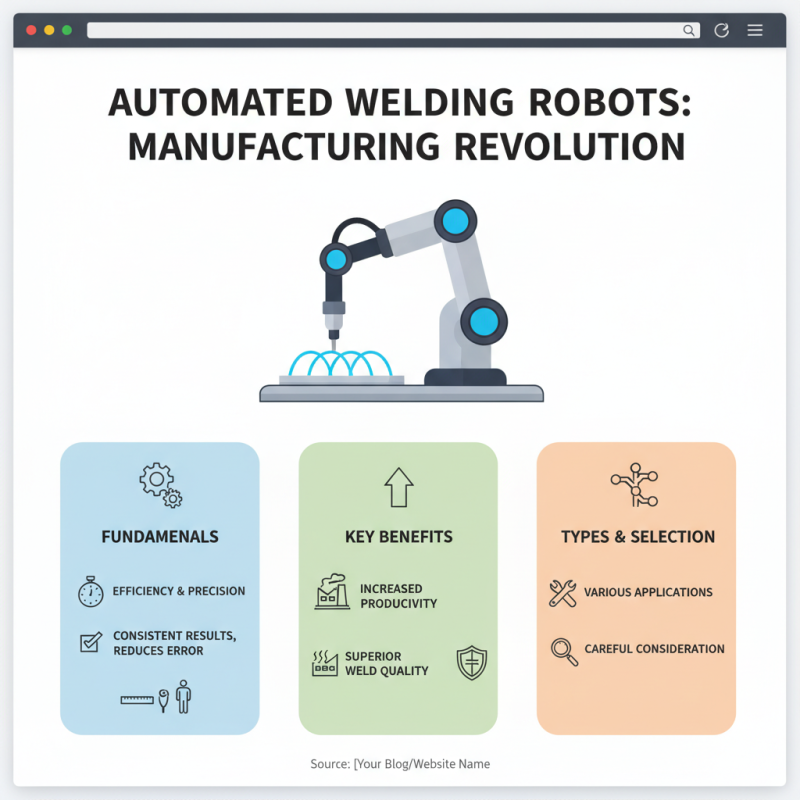
Automated welding robots are revolutionizing manufacturing. Understanding their fundamentals is essential for businesses looking to integrate this technology. These robots can enhance efficiency and ensure precise welds. They allow for consistent results while minimizing human error. Welding robots come in various types, each suited for different applications. Choosing the right one requires careful consideration.
Consider the size and weight of the components to be welded. Some robots handle heavy materials, while others excel with lighter items. Speed is another important factor. Faster robots often lead to increased productivity. However, faster doesn't always mean better. Sometimes, slower robots provide higher quality welds. Assess the complexity of your projects to find the right balance.
Another aspect to reflect on is the learning curve. Some welding robots are user-friendly, while others require specialized training. Technical support is vital. Ensure that you can access help when needed. Additionally, think about the cost. Initial investments can be high, but the savings in labor and improved quality may offset this. Explore options thoroughly to find a suitable investment for your business's future.
Key Features to Consider When Choosing a Welding Robot
When selecting an automated welding robot, it’s crucial to consider several
key features. The
payload capacity is one of the most
important factors. This determines how much weight the robot can handle. If
the materials are too heavy, it can strain the system. Additionally, the
reach of the robot is vital. A robot
with limited reach may not fit all tasks, leading to inefficiency.
Another aspect to evaluate is the
precision of the welding robot. A
higher precision level results in better weld quality. However, achieving
precision can require significant adjustments. Mistakes in calibration can
lead to wasted materials and time. The ease
of programming is also essential. A user-friendly interface could minimize
training time for staff. Complex programming might deter employees from
using the robot fully.
Safety features must not be overlooked. Robots are powerful tools
that can cause accidents if not properly equipped. Consider robots with
advanced safety protocols to protect operators. Sometimes, too much
automation can create a disconnect in the workflow. Balancing automation
with human oversight is key. Overall, carefully assessing these features
ensures that the welding robot meets specific business needs.
Assessing Your Business Needs for Automation in Welding
When thinking about automation in welding, it's crucial to assess your specific business needs. Start by evaluating your current production volume. Are you meeting your daily targets? If not, an automated welding robot might enhance your efficiency. Consider the complexity of your projects, too. Intricate designs could require advanced robotics, not just basic models.
Next, think about your workforce. Are your welders overburdened? Automation can alleviate their workload but may also replace jobs. This can be a sensitive topic. Balancing efficiency with employee morale is essential. You should also reflect on the quality of your output. If defects plague your products, robots can provide consistent precision. However, they require proper programming and maintenance.
Also, factor in your budget. Initial investments can be steep. Assess the long-term ROI. Automation can save time and reduce errors, but software and training costs can add up. Determine if your business is ready for this shift. Just because others are automating doesn’t mean it’s the right move for you. Look inward before making any decisions on automation.
Evaluating Cost and ROI of Automated Welding Solutions
Automated welding solutions are increasingly essential in today's manufacturing landscape. Evaluating the cost and ROI of these systems is crucial for businesses. According to the International Federation of Robotics, companies can save up to 30% on labor costs with automation. However, the initial investment can be daunting.
When assessing potential welding robots, consider their integration costs. Many systems require alterations in workflow, which can escalate expenses. A report by PwC indicates that 52% of companies see a payback period within three years of investing in automation. Yet, not all robots are suitable for every industry.
Tips: Conduct a thorough analysis of your specific needs before purchasing. Engage with consultants who can provide insights. Prioritize safety features, as these can affect long-term savings.
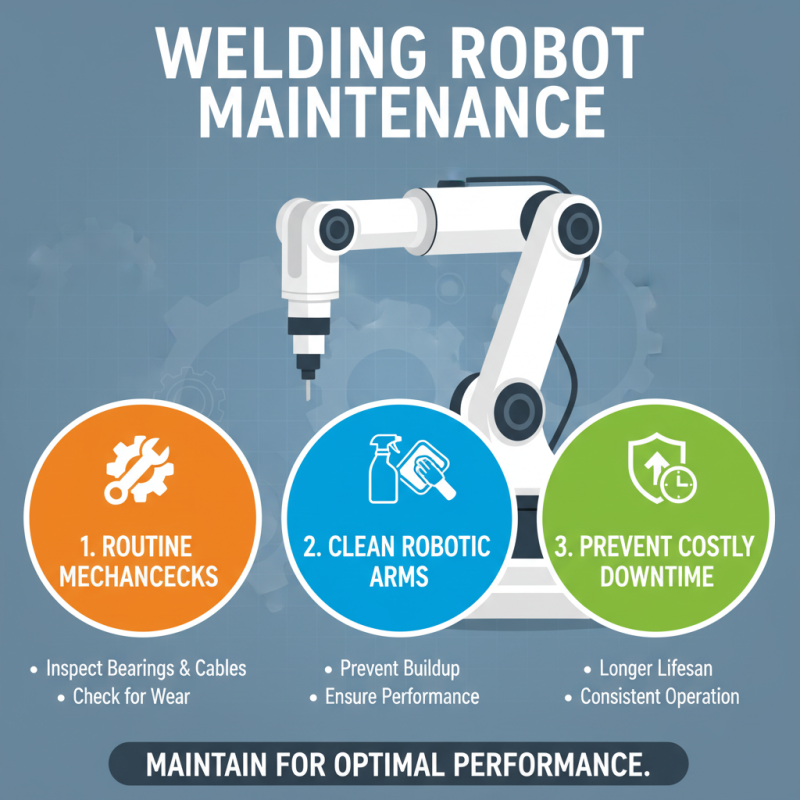
Evaluate hidden costs too. Maintenance, training, and software upgrades can pile up. Investing in user-friendly technology can reduce training costs. Remember, not all automation leads to an immediate boost in productivity; continuous evaluation is key.
2026 How to Choose the Best Automated Welding Robot for Your Business - Evaluating Cost and ROI of Automated Welding Solutions
| Features |
Cost ($) |
Annual Maintenance Cost ($) |
Projected Annual Savings ($) |
ROI (%) |
| Basic Model |
15,000 |
1,500 |
5,000 |
23.81 |
| Advanced Model |
25,000 |
2,500 |
12,000 |
40.00 |
| Premium Model |
35,000 |
3,500 |
20,000 |
48.86 |