
How to Choose a PET Flexible Circuit Supplier?
Choosing a Pet Flexible Circuit supplier involves more than comparing quotes. The supplier’s material choices, fabrication controls, and communication can affect fit, durability, and delivery. PET films may suit lightweight designs, but the right construction depends on the circuit’s layout and operating conditions. A material label alone is not enough.
A clear sample helps. It does not prove consistent production. Ask how the supplier controls film thickness, copper patterning, coverlay alignment, and finished-circuit dimensions. Request relevant test records and inspect samples for uneven edges, wrinkles, lifted traces, or inconsistent spacing. Small defects can create problems during assembly. That matters.
Share realistic requirements before requesting a price: drawings, quantities, bend locations, connector details, and expected use conditions. Then check whether the supplier identifies missing information or simply agrees to everything. A careful review can reveal risks early. It may also expose gaps in your own specification.
Cost and lead time still count, but unusually low pricing deserves questions about materials, inspection, and process consistency. No supplier is perfect. Look for specific answers, traceable quality practices, and a workable plan for handling changes or defects. This guide explains the key points to assess, from technical capability and sample evaluation to communication and long-term reliability, so you can choose a Pet Flexible Circuit partner with clearer expectations.
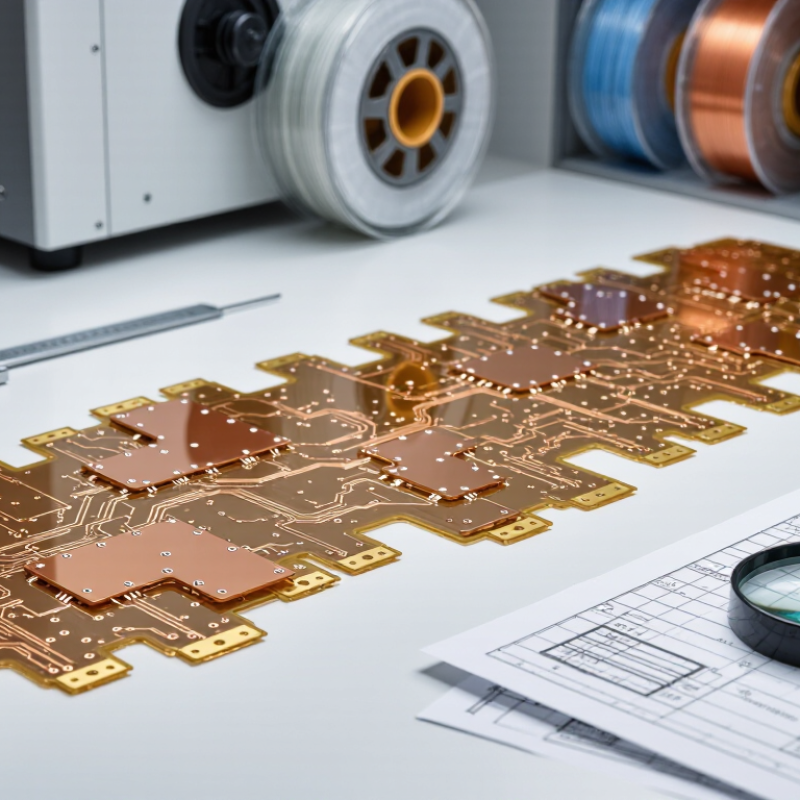
Define Your PET Flexible Circuit Requirements
Before comparing PET flexible circuit suppliers, define what the circuit must do in its finished product. Record its outline, maximum thickness, bend direction, and whether it will flex repeatedly or only during installation. Include a simple drawing with connector locations and keep-out areas. Small details matter. A 2 mm shift can affect how the circuit fits inside a compact housing.
Specify electrical needs, too. List operating voltage, expected current, signal type, and any impedance target. Describe the actual environment: temperature range, humidity, exposure to oils, and expected service life. State whether the PET film needs a particular adhesive or surface finish. If a requirement is still uncertain, mark it as open rather than treating an early guess as a fixed specification.
Set practical expectations for samples and production. Give the supplier your prototype quantity, estimated annual volume, and preferred inspection criteria. Ask how they will verify dimensions, continuity, and bend performance. Measure twice. It is tempting to demand the tightest possible tolerances, but tighter limits can raise cost without improving function. Review the first sample in the real assembly, not just on a flat bench. A small routing change may reveal that your original drawing missed a mounting constraint. That is useful feedback, not a failure.
How to Choose a PET Flexible Circuit Supplier? - Define Your PET Flexible Circuit Requirements
| Requirement | Details to Define | Practical Planning Guidance | What to Confirm with the Supplier |
|---|---|---|---|
| Circuit function | Signal, power, sensor, keypad, LED, or other application; operating voltage and current. | List the electrical loads and required connections. Current capacity depends on conductor width, copper thickness, temperature rise, and heat dissipation. | Ask for design-rule review, current-carrying guidance, and any needed thermal or voltage-drop assessment. |
| PET film and thickness | PET grade, film thickness, color, surface finish, and any transparency requirement. | PET film thickness is commonly selected from material and application needs; approximately 0.05–0.25 mm is a useful early design range, not a universal limit. | Confirm available film grades, thickness tolerances, dielectric data, and suitability for the expected temperature and environment. |
| Conductor material and thickness | Copper, printed conductive ink, or another conductor; thickness or specified sheet resistance. | Copper thickness affects resistance, flexibility, and fabrication. Printed conductors may be suitable for some low-current designs but have different resistance and process characteristics. | Request the proposed conductor construction, resistance data, adhesion information, and process capability for the chosen material. |
| Trace and spacing rules | Minimum and nominal trace width, spacing, tolerances, and any controlled-impedance requirement. | Set rules from electrical needs and the selected manufacturing process. Fine-line capability varies by conductor type, thickness, and production method. | Have the supplier review the CAD data and confirm achievable line/space dimensions and relevant inspection methods before release. |
| Layer count and construction | Single-sided or double-sided circuit, insulation layers, coverlay or overcoat, and exposed contact areas. | A simpler construction can reduce process complexity. Double-sided designs may require additional alignment, insulation, and interconnection considerations. | Request a proposed layer stack-up, material specifications, and details of how vias or layer-to-layer connections are made, if required. |
| Bend and flex conditions | Static bend or repeated flexing, bend radius, direction, cycle count, and locations of bends relative to traces. | Repeated flexing generally requires more conservative material and layout choices than a one-time installation bend. Avoid placing sharp corners or stress points in bend zones. | Confirm that the proposed construction is suitable for the stated bend radius and cycle target; request test evidence when flex life is critical. |
| Connectors and contacts | Connector type, contact pitch, contact dimensions, insertion requirements, and contact finish. | Define the mating component and mechanical tolerances early. Contact finish and exposed-pad design should match the connection method and expected use. | Verify contact dimensions, finish, alignment tolerances, and compatibility with the intended connector or assembly process. |
| Environmental conditions | Operating and storage temperatures, humidity, UV exposure, chemicals, abrasion, and expected service life. | PET properties and adhesive or coating performance vary by grade and construction. Specify the actual exposure conditions rather than relying on a generic material label. | Request relevant material data and, where needed, qualification testing against the defined environment and acceptance criteria. |
| Outline and tolerances | Overall dimensions, cutout locations, edge tolerances, registration needs, and panelization requirements. | Include critical-to-fit dimensions and identify datums. Tolerances should reflect the actual assembly interface and manufacturing process. | Ask for a capability review of critical dimensions and confirm the measurement method and inspection sampling plan. |
| Quality and testing | Electrical continuity, isolation, visual criteria, dimensional inspection, adhesion, and any application-specific tests. | Define pass/fail limits and test coverage before quotation. Testing should correspond to the design risks and the product's intended use. | Confirm available test equipment, inspection records, traceability options, and how nonconforming parts are handled. |
| Volume and lifecycle | Prototype quantity, annual demand, batch size, forecast, and expected product lifecycle. | Tooling, panelization, and process choices can differ between prototypes and production. Provide realistic forecasts to support planning and cost estimates. | Request separate prototype and production quotations, lead-time assumptions, tooling details, and change-control expectations. |
| Design files and documentation | Gerber or other fabrication files, drill data if applicable, stack-up, outline, drawings, BOM, and revision level. | Keep file revisions aligned and include notes for critical features, test requirements, and assembly interfaces. A drawing can clarify requirements not captured in artwork. | Confirm the supplier's preferred file formats, data-check process, and approval workflow before manufacturing starts. |
Planning ranges are indicative only. Final design limits depend on the selected PET grade, conductor system, circuit construction, and supplier process capability.