
Accordian Closable

Top 10 555 IC Timer Circuit Manufacturers Worldwide

The 555 Ic Timer Circuit remains a practical choice for timing, pulse generation, and oscillator designs. Its appeal is easy to see on a workbench: a few external components can produce a repeatable blink, delay, or square wave. Yet choosing a manufacturer involves more than comparing pin-compatible parts. Engineers also consider supply continuity, operating temperature, package options, documentation, and support.

The wider chip market provides useful context, but not a direct measure of 555 timer demand. The Semiconductor Industry Association reported global semiconductor sales of $627.6 billion in 2024, up 19.1% from 2023. That figure describes the whole semiconductor industry, not the 555 timer segment. It still highlights the scale and competitiveness of the supply chain serving component buyers. For this ranking, manufacturer capabilities and verifiable product information matter more than broad market size.

Hans Camenzind, the 555’s designer, emphasized versatility in his published account; paraphrased, his design principle was to make a useful timer adaptable across many applications. That principle remains relevant. A classroom circuit, an industrial control board, and a low-power portable device can place very different demands on the same basic timer. There is no single best supplier for every design. Some comparisons also rely on incomplete public information, so rankings deserve scrutiny. The following Top 10 555 IC Timer Circuit Manufacturers Worldwide introduces companies whose products, technical resources, and market presence help engineers evaluate their options. Check the datasheet carefully. A familiar part number does not guarantee identical specifications.
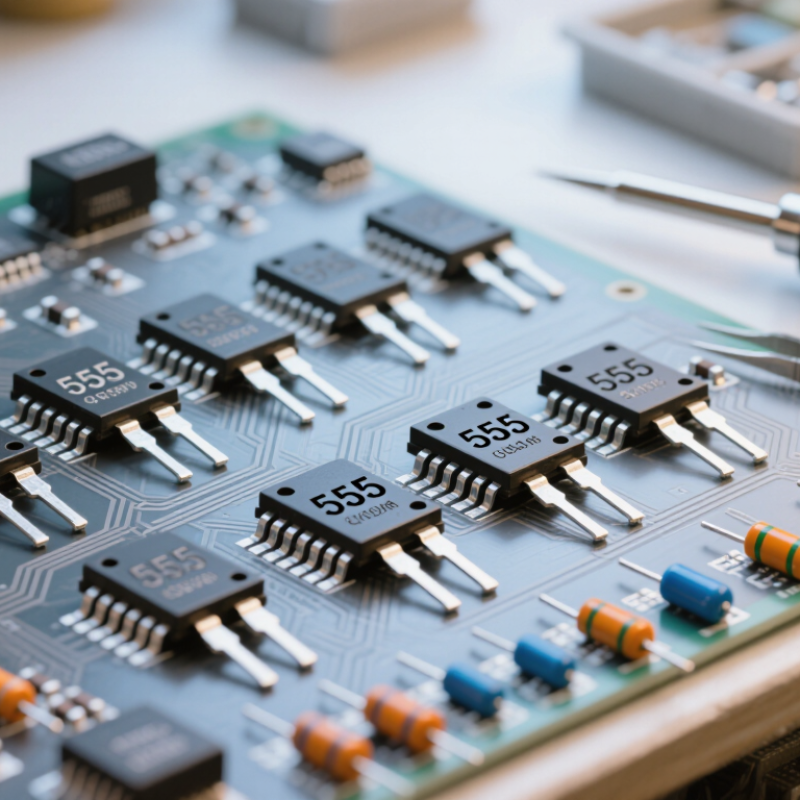
Top 10 555 IC Timer Circuit Manufacturers Worldwide

What a 555 Timer IC Is and How It Works

Top 10 555 IC Timer Circuit Manufacturers Worldwide

What a 555 Timer IC Is and How It Works

A 555 timer is a compact timing circuit that turns changing voltages into timed output signals. Inside, a resistor divider sets reference levels near one-third and two-thirds of the supply voltage. Two comparators monitor the trigger and threshold pins. Their signals control a latch, an output stage, and a transistor that can discharge an external capacitor. In a monostable circuit, one trigger creates a single pulse; its duration is roughly 1.1 × R × C. In astable mode, the capacitor repeatedly charges and discharges, producing a continuous pulse train. Simple, but not magic.

The wider semiconductor market shows why even familiar building blocks remain relevant. The Semiconductor Industry Association, citing WSTS data, reported global semiconductor sales of $627.6 billion in 2024, up 19.1% from 2023. That figure covers the entire chip market, not 555 timers specifically.

For designers, the practical lesson is to check the exact timer’s supply range, output current, timing accuracy, and temperature behavior. Bipolar and CMOS versions can differ in power use and input characteristics. A neat calculation may still drift when capacitor tolerance, leakage, and board contamination enter the picture.

Tips: Start with a measured capacitor value, then verify the pulse on an oscilloscope. Long wires can add noise.

How to Evaluate 555 Timer IC Manufacturers Worldwide

Choosing a 555 timer IC manufacturer takes more than comparing unit prices. Check the datasheet for timing range, supply voltage, output drive, and operating temperature. These details matter when a circuit must blink reliably in a warm enclosure or drive a small relay. Confirm that the manufacturer provides revision-controlled documentation and clear package dimensions. Missing or vague specifications deserve a follow-up question.

Assess quality evidence with care. Ask about production testing, lot traceability, and how component changes are communicated. If possible, request samples and test them in your own circuit across expected voltage and temperature conditions. A clean bench result is useful, but it does not prove long-term consistency. Review lead times and packaging, too; moisture-sensitive parts need suitable storage and handling. No checklist is perfect, and a polished webpage is not proof of dependable production.

Tips: Compare datasheets line by line. Test samples under real load. Ask for written answers about traceability and change notices. Keep notes on response time and technical clarity. A manufacturer may look strong on paper yet offer slow support; that trade-off is easy to overlook.

Top 10 555 IC Timer Circuit Manufacturers Worldwide

The global market for 555 IC timer circuits includes semiconductor manufacturers, analog-circuit specialists, and suppliers serving industrial and consumer electronics. Comparing the top ten requires more than checking output volume. Look for stable timing performance, clear datasheets, and practical application guidance. Small details matter. A tolerance figure, operating-temperature range, or startup note can affect a design on the workbench.

Manufacturers differ in packaging, supply availability, and support for standard and low-power versions. For a pulse generator or LED flasher, engineers should compare timing accuracy, output drive limits, and behavior across changing supply voltages. Review sample availability and production continuity, too. Useful evidence includes published electrical tests, traceable specifications, and responsive technical support. A neat specification sheet is helpful, but it does not answer every question. Bench testing remains important, especially when a circuit must run for long periods. This comparison is not perfectly tidy: product lines change, and distributor listings may lag behind current documentation. Check the latest datasheet before selecting a supplier.

555 Timer Circuit Design: Monostable Pulse Width by Timing Capacitor

Calculated using the ideal monostable equation t ≈ 1.1 × R × C, with a fixed 100 kΩ timing resistor. These are illustrative circuit calculations, not manufacturer or brand rankings. Actual timing may vary with component tolerances and circuit conditions.

Key Products and Applications of Leading 555 Timer Manufacturers

Leading 555 timer manufacturers generally supply bipolar and CMOS versions, plus single and dual timer packages. Bipolar devices suit robust pulse generation and simple delay circuits. CMOS versions reduce standby current, making them useful in battery-powered alarms, portable instruments, and sensor interfaces. Common applications include LED flashers, tone generators, oscillator circuits, and PWM motor control. Package options and operating-voltage ranges vary, so engineers should compare datasheets rather than assume products are interchangeable.

The wider market provides useful context: the Semiconductor Industry Association reported global semiconductor sales of $627.6 billion in 2024, up 19.1% from 2023. This figure covers the whole semiconductor industry, not the 555 timer segment.

Product choice depends on the job. A workshop pulse generator may prioritize stable timing and easy adjustment, while a compact alarm may need low quiescent current. Manufacturers also differ in temperature ratings, output drive, and available packaging. For production designs, check timing tolerance across temperature and supply voltage; a circuit that works on a bench may drift in the field. That detail is easy to overlook.

Tips: Use the timing formula as a starting point, then verify it with measured resistor and capacitor values. Small part. Big impact. Also test the output under the actual load, especially when switching a relay or motor. Timer circuits are simple, but wiring and component tolerances still matter.

How to Select a 555 Timer IC Manufacturer for Your Project

Selecting a 555 timer IC manufacturer starts with the circuit, not the catalog price. Check timing accuracy, supply voltage, temperature range, output drive, and package dimensions against your design. For a monostable circuit, compare the specified timing error with your actual resistor and capacitor tolerances. A few percent can matter. Ask for datasheets, lot traceability, and change-notification procedures. These details help distinguish documented production control from attractive sample performance.

Supply continuity deserves equal attention. The Semiconductor Industry Association, citing WSTS data in its February 2025 release, reported global semiconductor sales of $627.6 billion in 2024, up 19.1% year over year. That figure describes the wider chip market, not 555 timer availability. Still, it shows why buyers should check lead times, lifecycle status, and authorized sourcing before committing a board design. Request recent production and delivery records where possible.

For prototypes, test several units across expected temperatures and supply voltages. Measure pulse width, restart behavior, and output levels with the same components planned for production. Ask whether the manufacturer can provide qualification data against relevant JEDEC reliability methods, such as JESD47. A polished datasheet is useful, but it cannot replace bench checks. I would also compare second-source options early; this takes effort, and sometimes the best paper choice performs less neatly on the bench.

Top 10 555 IC Timer Circuit Manufacturers Worldwide - How to Select a 555 Timer IC Manufacturer for Your Project

Selection checklist: The rows below compare practical supplier and product evaluation criteria, not named companies or a verified manufacturer ranking. 555 timer specifications vary by device and manufacturer; confirm details in the current datasheet.

No. Selection dimension What to verify Practical guidance
1 Device type and operating principle Check whether the timer uses a bipolar or CMOS design, and review its specified supply-voltage range, operating current, and output characteristics. Choose against the circuit’s actual power and output requirements. Supply-voltage limits and current consumption differ among 555-family devices.
2 Electrical specifications Review timing accuracy, threshold and trigger levels, supply-current limits, output drive, and discharge-pin ratings in the datasheet. Compare devices under the conditions relevant to the design, including supply voltage, load, temperature, and timing-component tolerances.
3 Temperature range Confirm the rated operating-temperature range and whether the quoted specifications apply across that full range. Match the rating to the expected ambient and board temperatures. Do not assume all devices in the 555 family have the same range.
4 Package and footprint Check package type, body dimensions, pin arrangement, thermal limits, and the availability of the package needed for assembly. Verify the package drawing and pinout before layout or substitution; packages with similar names may not share the same footprint.
5 Datasheet and technical support Look for a current datasheet, application guidance, electrical-characteristic tables, package information, and a clear channel for technical questions. Use published specifications and written technical responses to resolve design questions rather than relying on generic descriptions.
6 Quality and traceability Ask how product lots are identified, how incoming and outgoing quality are managed, and what documentation is available for shipped parts. For critical or regulated applications, define lot-traceability and inspection requirements before placing an order.
7 Compliance documentation Request applicable declarations and material-compliance information for the exact device and package being purchased. Check that documents correspond to the ordered part and destination market; do not infer compliance from a supplier’s general statement.
8 Lifecycle and change notices Confirm current availability, order status, product-change notification practices, and any published end-of-life information. For long-lived designs, ask how much notice is provided for material, process, package, or product-status changes.
9 Supply capability and lead time Obtain a dated quotation covering order quantity, minimum order requirements, lead time, shipping terms, and available inventory status. Treat inventory and lead-time figures as time-sensitive, and confirm them for the required quantity before committing to a schedule.
10 Sampling and verification Determine whether samples or evaluation quantities are available and whether the supplier can provide test or inspection records. Evaluate representative parts in the intended circuit and compare measured behavior with the datasheet before production release.