
What Are the Top 10 Robot Machines for Industrial Buyers?
Choosing a robot machine is not a popularity contest. The right choice depends on the task, workspace, payload, cycle time, and the people who will maintain it. Joseph Engelberger, a pioneer of industrial robotics, is often credited with saying, “I can’t define a robot, but I know one when I see one.” The line is memorable, but buyers need more than recognition. They need measurable requirements and evidence from real production conditions.
This guide examines ten robot machine types industrial buyers commonly consider, including articulated arms, SCARA robots, delta systems, and autonomous mobile robots. Each serves different needs. A palletizing arm may lift heavy cartons at the end of a line; a compact SCARA robot may place small components with fast, repeated motions. Details matter. Ask about reach, payload at full extension, accuracy, guarding, integration, spare parts, and expected service intervals. A brochure may show impressive speed, yet leave out setup time or difficult maintenance. That gap can be costly.
The ranking is a starting point, not a universal verdict. A robot that fits an automotive cell may be wrong for a small food-processing line. Buyers should compare operating costs and request a demonstration using representative parts. Watch the full cycle. Listen for hesitation. Check how quickly an operator can recover from a fault. Even these checks have limits; a short demo cannot prove years of reliability. Use the list to ask better questions, then verify each machine against your process.
Industrial Robot Machines: Types, Functions, and Key Terms
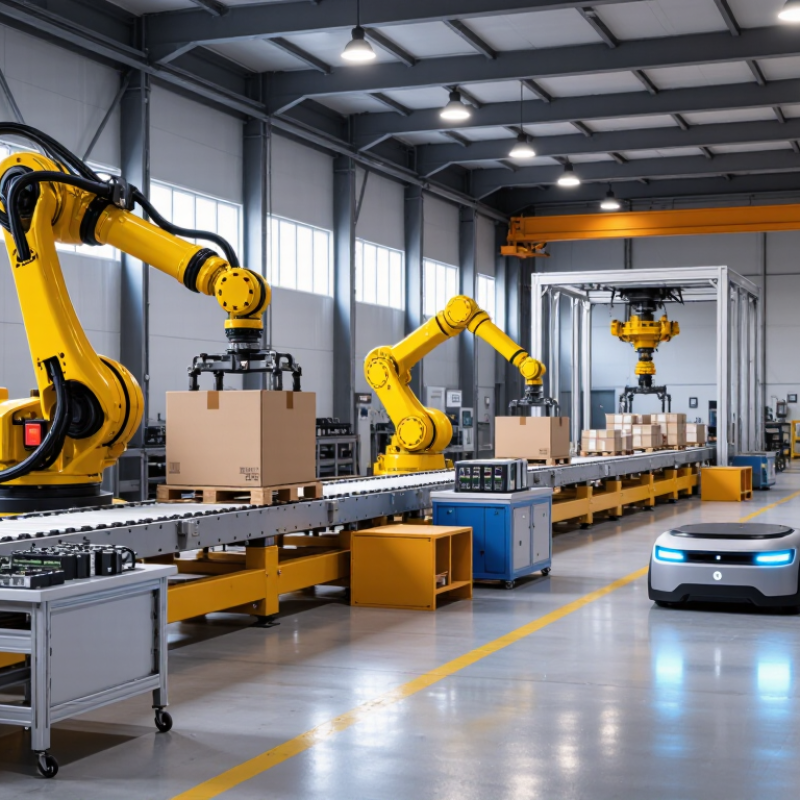
Industrial robot machines differ by how they move and what tasks they handle. Articulated arms use rotating joints for welding, machine tending, and palletizing. SCARA robots suit fast assembly on flat work surfaces, while Cartesian robots travel along straight axes for precise loading or dispensing. Delta robots pick small items quickly from a conveyor. Cylindrical and polar designs serve more specialized work areas.
Collaborative robots are designed to work near people, but a risk assessment is still essential. Mobile robots move materials between stations; gantry robots cover large, rectangular work zones. That matters. A machine’s type alone does not determine whether it fits a production line. Consider the part’s weight, required speed, available floor space, and how operators will load and maintain equipment.
Key terms help buyers compare machines accurately. Payload is the total weight a robot can carry, including its tooling. Reach describes how far its arm can extend. Repeatability indicates how consistently it returns to a position; it is not the same as absolute accuracy. Cycle time measures task duration, while the work envelope is the robot’s usable operating area. An end effector is the tool at the robot’s wrist, such as a gripper or welding head. Degrees of freedom describe independent movement axes. Measure twice. I have seen specifications look convincing on paper, yet a bulky gripper or awkward cable route can limit access in practice.
What Are the Top 10 Robot Machines for Industrial Buyers?
This is a practical shortlist of common industrial robot categories, not a ranked sales list. Payload, reach, speed, and configuration vary by model and application. Some categories overlap: for example, a collaborative robot may also be an articulated robot.
| Robot Type | Typical Motion / Axes | Common Industrial Functions | Key Terms | Buyer Considerations |
|---|---|---|---|---|
| Articulated Robot | Usually 6 rotary axes; arm geometry and available axes vary. | Welding, machine tending, material handling, assembly, painting, and palletizing. | Reach, payload, repeatability, joint limits, end effector | Check whether the robot can reach every required point while carrying the tool and workpiece. Review mounting position, cycle time, and workcell safeguards. |
| SCARA Robot | Commonly 4 axes, with selective compliance in the horizontal plane. | High-speed pick-and-place, small-part assembly, insertion, and packaging. | SCARA, cycle time, vertical stroke, repeatability | Often suited to fast planar operations. Confirm vertical travel, payload, work area, and whether the process requires more complex orientation control. |
| Cartesian Robot | Typically 3 linear axes; additional axes may be added. | Machine loading, dispensing, inspection, pick-and-place, and positioning. | Linear axis, stroke, gantry, working envelope | Assess travel on each axis, support structure, installation footprint, and protection against dust, liquids, or other process hazards. |
| Gantry Robot | Cartesian-style motion on an overhead or floor-mounted frame; axis count depends on configuration. | Large-area material handling, palletizing, machine tending, and assembly. | Gantry, span, travel, structural deflection | Useful when a large work area is needed. Check building clearance, frame stiffness, foundation requirements, and access for maintenance. |
| Delta Robot | Usually 3 parallel arms for fast XYZ movement; a tool-rotation axis may be added. | High-speed sorting, small-item picking, food handling, and packaging. | Parallel robot, cycle time, top-mounted, payload | Best suited to relatively light loads and a defined working zone. Verify product orientation needs, workspace shape, and hygiene or washdown requirements. |
| Collaborative Robot (Cobot) | Often an articulated arm, commonly with 6 axes; configurations vary. | Assembly, inspection, light machine tending, and flexible production tasks. | Power and force limiting, risk assessment, hand guiding, safety-rated monitored stop | “Collaborative” does not automatically mean safe for every shared workspace. Assess the complete application, including tooling, workpiece, speed, and stopping distance. |
| Cylindrical Robot | Typically one rotary axis and two linear axes. | Machine loading, material handling, and operations around a central column. | Rotary base, linear stroke, cylindrical workspace | Consider whether the cylindrical work envelope matches the cell layout. Compare access, reach, payload, and interference with nearby equipment. |
| Spherical (Polar) Robot | Typically two rotary axes and one linear axis. | Material handling, machine loading, and applications requiring a broad reach around the base. | Polar coordinates, reach, joint limits, work envelope | Check access to target points throughout the motion range, including potential joint-limit restrictions and collision risks. |
| Automated Guided Vehicle (AGV) | Mobile platform motion; navigation and steering configuration vary. It may carry a load or tow equipment. | Repeatable transport along defined routes in factories and warehouses. | Guided route, navigation, load capacity, traffic management | Review route changes, floor conditions, aisle width, charging needs, load stability, and how the vehicle will interact with people and other traffic. |
| Autonomous Mobile Robot (AMR) | Mobile platform with onboard sensing and navigation; mobility design varies. | Flexible material transport, replenishment, and movement between workstations. | Localization, mapping, obstacle detection, fleet management | Evaluate navigation performance in the actual facility, traffic integration, payload handling, charging strategy, and compatibility with doors or lifts. |
Related Posts
-

How to Choose the Right Robot Machine for Your Business Needs
-
Top 10 Robot Parts You Need for Efficient Automation?
-

Top Benefits of Robotic Automation for Businesses in 2023
-

Revolutionizing Efficiency: How Robotic Process Automation Solutions Transform Modern Workflows
-

How to Leverage Robotic Automation for Business Efficiency?
-

2026 Best Types of Robotic Process Automation for Buyers