What Are the Top AI Robot Manufacturers in China?
China’s Ai Robot industry is moving beyond laboratory demonstrations. Manufacturers now build machines for factory floors, warehouses, hospitals, and public-facing services. Their products range from compact inspection units to humanoid platforms with articulated hands and walking legs. A polished video, however, does not prove reliable performance. Buyers need to look at operating conditions, maintenance requirements, safety features, and long-term support.
This guide examines leading Chinese manufacturers, including companies known for industrial robotics, service robots, and emerging humanoid systems. It compares their visible strengths, product focus, and practical applications rather than treating every company as a direct rival. A robot that moves boxes on a production line serves a different need from one designed to greet visitors or assist researchers. Details matter: payload capacity, battery life, navigation around obstacles, and access to replacement parts can shape a purchase decision.
The market changes quickly. Some capabilities are easier to verify than others, and company announcements may not reveal how a system performs after months of daily use. That gap deserves attention. Readers should weigh independent demonstrations and customer evidence alongside manufacturer specifications. No single ranking can suit every buyer. The right choice depends on the task, budget, service network, and acceptable level of risk. This overview offers a grounded starting point, while recognizing that real-world results may differ from the promise of a showroom demo.
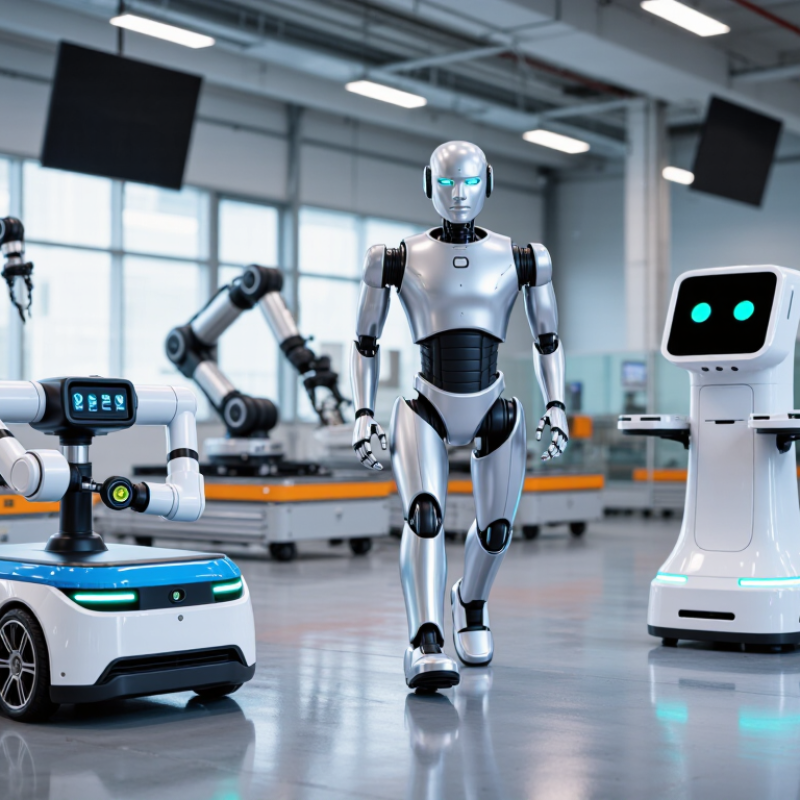
What Defines an AI Robot Manufacturer? China Installed 276,288 Industrial Robots in 2023 (IFR)
China installed 276,288 industrial robots in 2023, according to the International Federation of Robotics’ World Robotics 2024 report. That represented about 51% of global installations. The figure shows the scale of China’s factory automation market, but it does not measure how many robots use AI. That distinction matters.
An AI robot manufacturer does more than assemble arms and bases. It needs to combine mechanical engineering, sensors, control software, and systems integration. In a factory, that might mean a robot recognizing a shifted component on a conveyor, adjusting its grip, and pausing when a person enters its work area. A fixed, repetitive motion alone is not intelligence. Not quite. Buyers should also examine how a system performs in real operating conditions, not only in a polished demonstration.
IFR’s World Robotics 2023 report put China’s operational industrial robot stock at about 1.76 million units. That installed base creates opportunities for upgrades, maintenance, and new applications. Still, national totals cannot show which manufacturers deliver reliable perception or useful AI. A more grounded assessment asks whether a robot handles changing parts, recovers from errors, and fits existing production lines. Even experienced buyers can overlook integration costs. That remains a practical weakness in many comparisons.
What Are the Top AI Robot Manufacturers in China? — What Defines an AI Robot Manufacturer? China Installed 276,288 Industrial Robots in 2023 (IFR)
A practical comparison framework for evaluating AI robot manufacturers, alongside verified context on China’s industrial robot market. No company or brand ranking is implied.
| Dimension | What to assess | Relevant evidence or benchmark |
| Industrial robot definition | Check whether the product is an automatically controlled, reprogrammable, multipurpose manipulator programmable in three or more axes. | This is the core industrial robot definition in ISO 8373 terminology. |
| AI functionality | Look for specific, demonstrable capabilities such as machine-vision inspection, perception, adaptive planning, or learning-based control. | “AI robot” is a capability description, not a separate robot category in the ISO industrial-robot definition. Assess functions and application results rather than the label alone. |
| China installations in 2023 | Use national installation volume to understand the scale of the deployment market—not to infer the performance of any individual manufacturer. | 276,288 industrial robots were installed in China in 2023, according to the International Federation of Robotics (IFR). |
| Share of global installations | Provides context for China’s position in the global industrial-robot market. | China accounted for about 51% of the 541,302 industrial robots installed worldwide in 2023 (calculated from IFR figures). |
| Installed robot base | Consider the existing installed base when assessing potential demand for integration, service, and upgrades. | China’s operational industrial-robot stock reached approximately 1.76 million units at the end of 2023 (IFR). |
| Application fit | Compare the robot’s task, payload, reach, cycle time, repeatability, environment, and required safety measures with the intended production process. | These are application-specific evaluation criteria; requirements vary by task and workcell. |
| Integration and support | Evaluate compatibility with production equipment and software, commissioning support, operator training, maintenance, and spare-parts availability. | Request documented specifications, service terms, and application references for the relevant use case; these vary by supplier and deployment. |
Sources: International Federation of Robotics (IFR), World Robotics 2024; ISO 8373, Robotics — Vocabulary. Market totals describe industrial robots and do not establish a ranking of AI robot manufacturers.
How China’s AI-Robot Industry Splits into Industrial, Service, and Humanoid Categories
China’s AI-robot industry is easier to understand by application than by a single ranking of manufacturers. Industrial suppliers build systems for welding, inspection, palletizing, and machine tending. A typical cell may combine an articulated arm, a camera, a safety fence, and control software. Buyers assess uptime, cycle consistency, integration support, and replacement-part costs. A polished demonstration is not enough.
Service-robot makers focus on repeated tasks in public and commercial spaces. Their machines may deliver meals through hotel corridors, scrub floors after closing, or guide visitors across a lobby. Navigation, obstacle detection, battery life, and fleet management matter more than lifting strength. Conditions change quickly. A chair moved ten centimeters can disrupt a route, exposing weaknesses that brochures may not mention.
Humanoid developers occupy a newer, less settled category. They aim to build machines that use tools and move through spaces designed for people, but reliable autonomy remains difficult. A robot lifting a box in a controlled lab is not yet a dependable warehouse worker. Manufacturers must demonstrate safety, maintenance needs, and useful operating hours beyond staged trials. The categories overlap, too. Boundaries are fuzzy, so comparisons remain imperfect.
Which Chinese Companies Lead Industrial Robotics: SIASUN, Estun, Efort, and Inovance
China’s industrial-robot market is large, but scale alone does not identify the strongest manufacturers. The International Federation of Robotics reported 276,288 installations in China in 2023, about 51% of global installations. It also found domestic suppliers held 47% of China’s market, up from 28% in 2017. That shift gives local makers a stronger base for testing products in busy factories.
Their strengths differ. One group offers broad robot portfolios, from handling arms to welding cells. Another pairs robot production with automation engineering for complete production lines. A third focuses on industrial arms and system integration, while a fourth brings strength in drives, controls, and factory automation.
These capabilities matter on the floor: a robot must repeat a weld accurately, recover smoothly after a stop, and fit existing equipment. Small details count. The IFR figures describe market share, not reliability or service quality. Buyers should check cycle-time trials, spare-parts access, and maintenance response at their own site.
I would not treat rising domestic share as proof that every local model suits every factory; published data cannot replace an application test.
Which Firms Lead Service and Humanoid Robotics: UBTECH, Unitree, Fourier, and Keenon
China’s service-robot and humanoid sectors are developing along different tracks. Service-robot makers focus on repeatable tasks in hotels, restaurants, hospitals, and commercial buildings. Picture a compact machine carrying meals through a busy corridor, stopping at an elevator, then navigating around a guest. Reliability matters more than a dramatic demonstration. A missed delivery can disrupt a shift.
Humanoid developers face a harder test. Their machines must balance, handle objects, and respond to changing surroundings. A robot picking up a box in a controlled lab is not yet proof of dependable factory work. The gap matters. Buyers should compare operating hours, maintenance needs, safety features, and performance across real sites, not just polished videos. Some companies show strength in mobility; others emphasize manipulation or customer-facing service. These are different capabilities, and rankings can blur them.
The market is moving quickly, but public demonstrations reveal only part of the story. Ask how often a unit needs human assistance, and what happens when its route is blocked. That detail is easy to miss. Even strong systems can struggle with messy floors, crowded rooms, or unusual requests. Careful evaluation is less exciting, perhaps, but more useful.
China’s Industrial Robot Installations, 2019–2023
China installed 276,288 industrial robots in 2023, the highest annual total outside the record set in 2022. These figures provide market context for robotics development; they do not measure service or humanoid robots specifically. Source: International Federation of Robotics, World Robotics 2024.
How to Compare Manufacturers: China Accounted for 51% of Global Industrial Robot Installations (IFR)
China’s scale changes how buyers should compare AI robot manufacturers. The International Federation of Robotics (IFR), in World Robotics 2024, reports that China installed 276,288 industrial robots in 2023, or 51% of the global total of 541,302. That is a strong signal of manufacturing capacity and market demand. But installation volume alone does not prove that a supplier’s AI performs well on your production line. That scale matters.
Compare manufacturers against the work your plant actually needs. Check whether robots can handle variable parts, recover from errors, and maintain accuracy across long shifts. Ask for cycle-time and uptime data from applications similar to yours, not just controlled demonstrations. Review service coverage, spare-part availability, software update policies, and integration support. IFR’s figures describe installations, not the performance or reliability of individual manufacturers. This distinction is easy to miss. I would also treat impressive AI claims cautiously until they are tested with your own parts and lighting conditions.
Tips: Request a pilot using real production tasks. Define pass criteria before testing, including accuracy, recovery time, and downtime. A small trial can reveal gaps that a polished demo cannot.