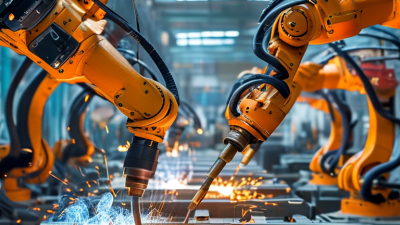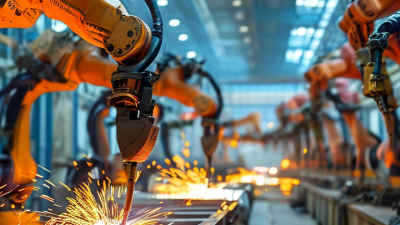
Robotic welding machine technology has moved from large automotive plants into shipbuilding, construction equipment, and smaller fabrication workshops. The International Federation of Robotics reported 541,302 industrial robots installed worldwide in 2023. Its World Robotics 2024 report also recorded more than 4.28 million industrial robots operating globally. These figures show strong automation demand, although welding represents only one part of the total market.
The best manufacturers are not judged by robot speed alone. Their systems must deliver stable arc control, accurate positioning, safe integration, and accessible service. A torch may repeat the same path hundreds of times, while a sensor corrects small joint variations. That detail matters.
This guide reviews leading robotic welding machine manufacturers worldwide through practical and technical criteria. These include payload range, controller reliability, welding software, offline programming, vision systems, and operator training. It also considers standards such as ISO 10218 for industrial robot safety and ISO 3834 for welding quality management. The American Welding Society continues to emphasize qualified procedures, trained personnel, and controlled process parameters.
Market reports do not always agree. Grand View Research, MarketsandMarkets, and Fortune Business Insights publish different forecasts because they define robotic welding markets differently. That limitation deserves attention. A large revenue estimate does not automatically identify the best supplier.
Real factory performance is more revealing. Downtime beside a welding cell can stop an entire production line. Spare-part access, integrator support, and local engineers may matter more than a polished brochure. The manufacturers highlighted here combine global reach with measurable welding expertise, but buyers should still validate claims through trials, references, and total lifecycle costs. Fresh data helps. Direct testing matters more.
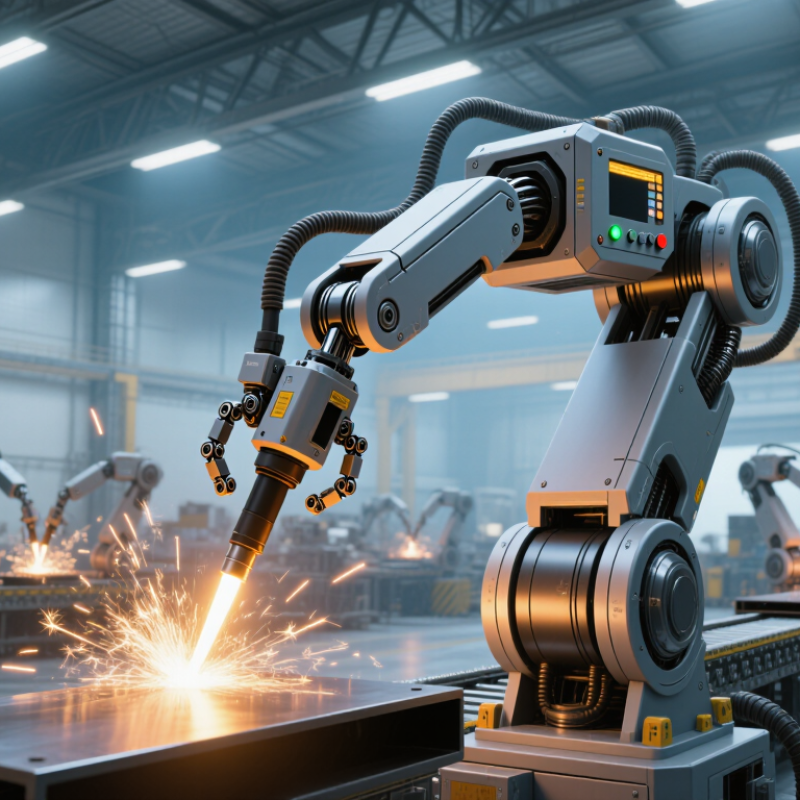
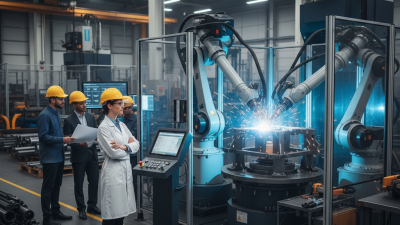
A robotic welding cell combines a six-axis arm, power source, positioner, torch, sensors, and safety controls. The robot follows programmed paths while the power source manages current, voltage, and wire speed. Common processes include gas metal arc welding, flux-cored arc welding, and laser-assisted welding. Each process suits different materials, joint designs, and production volumes.
The International Federation of Robotics reported 541,302 new industrial robots were installed worldwide in 2023. This figure shows growing automation demand, but installation volume does not guarantee welding quality.
Engineers should track cycle time, arc-on time, deposition rate, first-pass yield, and unplanned downtime. Weld penetration, bead width, spatter, and dimensional accuracy also need regular inspection.
ISO 9283 provides methods for measuring robot pose accuracy and repeatability. Those results can reveal drift before defects become expensive.
A practical cell should record every weld program revision, consumable change, and sensor alarm. Traceability matters. A camera may detect seam position, but it cannot replace sound joint preparation. That assumption needs testing.
The American Welding Society’s workforce studies continue to identify skilled welding expertise as a serious industry concern, so technicians must understand both metallurgy and robot programming.
In real production, a fast robot can still lose money through rework, fixture errors, or poor torch access. The best performance metric is not speed alone. It is stable output under changing material, operator, and maintenance conditions.
Top Robotic Welding Machine Manufacturers Worldwide
The global welding automation market is expanding alongside wider factory robot adoption. The International Federation of Robotics reported 541,302 industrial robots installed worldwide in 2023. That figure marked the second-highest annual installation level on record. It also shows the scale of modern manufacturing demand.
Welding remains a practical entry point for automation. A robotic cell can repeat torch movements, maintain programmed angles, and reduce exposure to fumes and heat. However, installation numbers do not tell the whole story. The IFR’s World Robotics 2024 report recorded 162 robots per 10,000 manufacturing employees globally in 2023. This average hides major differences between regions, factory sizes, and skill levels.
Real performance depends on more than the arm. Power-source stability, fixture accuracy, seam tracking, and operator training affect every weld. A poorly aligned fixture can create defects repeatedly, much faster than a human worker. That is an uncomfortable detail, but it matters. The International Federation of Robotics also noted that Asia accounted for about 70% of new industrial robot installations in 2023, reinforcing the region’s manufacturing influence.
When comparing robotic welding machine manufacturers, buyers should examine payload, reach, arc-control compatibility, service response, and programming time. Published cycle rates deserve careful testing. Real workshops contain dust, changing materials, and imperfect tolerances. A factory trial often reveals more than a polished specification sheet.
Top robotic welding machine manufacturers should be evaluated through measurable evidence, not showroom demonstrations. The International Federation of Robotics reported 541,302 industrial robot installations worldwide in 2023. That scale makes documented safety and performance essential. ISO 10218 should be checked for robot and system safety requirements, including safeguarding, risk assessment, emergency functions, and integration responsibilities. Ask for the exact certificate scope. A general compliance statement is not enough.
IP ratings, defined under IEC 60529, indicate protection against dust and water, but they do not prove welding durability. For a shop with smoke, spatter, and coolant mist, an IP65 or IP67 rating may be more suitable than a basic enclosure. Still, cable routing and torch protection matter. Payload calculations must include the torch, wire feeder, dress pack, and mounting hardware. A six-kilogram torch package can quickly reduce usable capacity.
Repeatability should be measured under ISO 9283 conditions, not quoted from an ideal laboratory test. A specification such as ±0.05 millimeters sounds impressive, yet thermal growth, fixture error, and torch wear can shift the weld path. Industry 4.0 deployment data often emphasizes connected automation, but connectivity cannot repair poor calibration. One weakness in my own screening is trusting numerical precision too early. Real weld samples, maintenance records, and independent acceptance testing reveal more. Short trials matter. Ask for failure data, too.
| Evaluation Dimension | Reference Standard or Technical Basis | Strong Market Benchmark | Acceptable Benchmark | Evidence to Request from a Manufacturer | Evaluation Weight |
|---|---|---|---|---|---|
| Robot safety compliance | ISO 10218 series for industrial robot and robot-system safety; ISO 12100 for machinery risk assessment. | Documented compliance Current declaration, risk assessment, safety-function validation, and technical file available. |
Compliance statement supplied, but supporting risk documentation requires further review. | Declaration of conformity, risk-assessment summary, safety-circuit validation, and applicable regional certifications. | 20% |
| Ingress protection of robot body | IEC 60529 IP Code. | IP65 or higher IP67 at the wrist or critical joints is preferred for weld spatter, dust, and cleaning exposure. |
IP54 for clean indoor areas with controlled contamination. | Complete IP rating by axis or component, test conditions, certificate, and exclusions for dress packs, connectors, and tooling. | 10% |
| Payload capacity | Rated payload must include the torch, hose package, mounting hardware, and any external tooling. | 10–25 kg for welding cells Suitable for heavy torch packages, positioners, and integrated process equipment. |
6–10 kg for standard arc-welding torches and compact dress packs. | Rated payload curve, wrist-moment limits, inertia limits, center-of-gravity limits, and payload verification method. | 15% |
| Position repeatability | ISO 9283 provides methods for evaluating pose accuracy and repeatability. | ±0.02 to ±0.05 mm Appropriate for consistent seam tracking and repeatable torch positioning. |
±0.05 to ±0.10 mm for general fabrication where process control compensates for variation. | Repeatability test conditions, pose configuration, payload, temperature, measurement method, and whether the value is unidirectional or multidirectional. | 15% |
| Reach and work envelope | Robot reach should be assessed against joint limits, torch access, fixture clearance, and cable routing. | 1.4–2.1 m reach Suitable for medium and large fabricated assemblies without excessive repositioning. |
0.9–1.4 m reach for compact fixtures and smaller workpieces. | Reach diagram, axis limits, allowable wrist orientations, singularity zones, and interference simulation. | 10% |
| Welding process integration | Compatibility with GMAW/MIG/MAG, FCAW, pulse welding, tandem systems, and applicable welding equipment interfaces. | Open integration architecture Digital I/O, fieldbus support, synchronized welding control, seam tracking, and collision detection. |
Basic analog or digital interface with standard welding programs. | Supported fieldbus protocols, communication cycle time, welding-power-source compatibility, torch-cleaning interface, and seam-tracking options. | 15% |
| Motion performance | Maximum speed alone is insufficient; assess cycle time under welding payload and process constraints. | High dynamic response Stable path motion, controlled acceleration, low vibration, and short settling time. |
Standard six-axis motion suitable for routine production with moderate cycle-time requirements. | Cycle-time demonstration, acceleration data, path accuracy results, vibration observations, and production sample welds. | 10% |
| Environmental suitability | IEC 60529 rating, operating-temperature limits, humidity limits, and welding-cell contamination requirements. | Industrial welding environment Protection against dust, weld spatter, oil mist, and routine thermal variation. |
Indoor, controlled-temperature operation with additional protective covers or maintenance controls. | Operating temperature, humidity, permissible contamination, chemical-resistance information, maintenance intervals, and replacement-part guidance. | 5% |
| Serviceability and lifecycle support | Assessment based on spare-parts availability, preventive-maintenance requirements, training, and regional technical support. | Long-term support structure Local service coverage, documented maintenance intervals, diagnostics, and defined spare-parts lead times. |
Remote technical support with limited local inventory or longer response times. | Warranty terms, mean time to repair, service locations, spare-parts lead times, software-update policy, and operator training plan. | 10% |
Robotic welding machine manufacturers differ sharply by region, platform, and production focus. East Asian suppliers often serve high-volume automotive lines, where six-axis arms, spot welding, and fast cycle times matter. European manufacturers commonly emphasize safety integration, traceability, and flexible arc welding cells. North American suppliers often build modular systems for heavy equipment, construction, and job-shop production. These patterns are useful, but they are not absolute.
Platform choice should match the weld, material, and operator skill. Fixed cells suit repeatable steel assemblies with stable fixtures. Collaborative platforms support lower-volume work and easier deployment, although their speed can be limited. Gantry systems handle large structures, while robotic arms provide better access around complex frames. Market data shows continued growth in automated welding, especially where labor shortages and quality controls affect output. However, published figures vary because researchers define “robotic welding” differently. A spreadsheet may look precise, yet its assumptions deserve inspection.
Tips: Compare total cost, not only the machine price. Check reach, payload, controller support, torch access, fixture accuracy, and local training. Request sample welds using your actual material and joint design. Review uptime records and maintenance response times. A short factory demonstration can reveal cable wear, awkward programming, or poor fume extraction. These details often matter more than impressive catalog specifications. Teams should also measure payback using real shift data, scrap rates, and changeover time. Estimates can be optimistic. Recheck them after a pilot run.
Regional industrial robot installations are used as a market-demand proxy for robotic welding equipment. China represented approximately 51% of the 541,302 industrial robots installed worldwide in 2023. The figures cover all industrial robot applications, not individual manufacturers or brands.
Source: International Federation of Robotics, World Robotics 2024. Values shown in units installed in 2023.
Top Robotic Welding Machine Manufacturers Worldwide
Application matters more than a supplier’s headline specifications. The International Federation of Robotics’ World Robotics 2024 report recorded 541,302 industrial robot installations worldwide in 2023. Automotive plants remain strong adopters because robots repeat short weld paths thousands of times. They suit body-in-white lines, where cycle time, arc stability, and fixture accuracy decide output. Steel fabrication needs a different approach. Parts may be thick, warped, or unusually shaped. Adaptive seam tracking, high-capacity positioners, and dust-resistant equipment become more valuable than raw speed. The World Steel Association reported global crude steel production of about 1.89 billion tonnes in 2023, showing the scale of this demanding sector.
Shipbuilding adds even more variation. Large panels, long seams, and changing work positions can limit the value of fixed cells. Rail-guided systems, offline programming, and portable welding units often fit better. SME welding cells need simpler programming, smaller footprints, and fast changeovers. Their production mix may change every few hours. That reality is easy to underestimate. A technically advanced cell can still fail commercially when operators avoid it or fixtures take too long to adjust. Reports provide direction, not a shop-floor guarantee.
Tips: Measure arc-on time, not just robot speed. Test three real parts before purchase. Record setup minutes, rework rates, and operator training time. For steel and shipbuilding, inspect tracking performance on imperfect joints. For SMEs, leave room for manual access. Automation is rarely perfect.