Accordian Closable

Which Robotic Welding Cell Is Best in 2026?

Choosing the best robotic welding cell in 2026 starts with the workpiece, not the robot’s brochure. Part size, material, joint access, and weekly production volume all shape the right choice. A compact cell may suit a shop handling short runs and frequent changeovers. A larger system may support repeat production, multiple fixtures, or longer weld seams. Neither is automatically better. The details matter.

This guide compares cell types through practical factors: reach, payload, positioning equipment, torch access, safety features, programming, and service support. It also considers what operators face on the floor, from loading fixtures to correcting a weld path after a part shifts slightly. Those small moments can affect uptime. A specification sheet rarely captures them well.

There is no universal winner. A cell that performs well on a clean sample part may struggle with variable fit-up or limited floor space. That is an uncomfortable gap in many buying decisions. Buyers should request a representative weld trial and verify cycle-time assumptions before committing. The comparison ahead can help narrow the field, but local support and real production tests still count. A little skepticism is useful.

Which Robotic Welding Cell Is Best in 2026?

Define Robotic Welding Cells: IFR Reported 541,302 Robot Installs in 2023

IFR’s World Robotics 2024 report counted 541,302 industrial robots installed worldwide in 2023, the second-highest annual total on record. This figure covers industrial robots across sectors, not welding cells alone. IFR reported that Asia accounted for about 70% of installations, Europe 17%, and the Americas 10%. Scale is real. Yet those totals do not show whether a particular weld will be consistent.

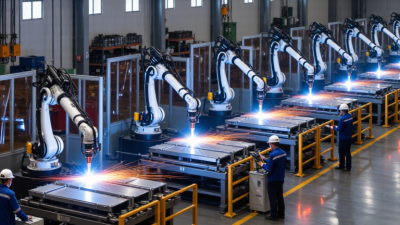
A robotic welding cell combines an industrial robot with a welding power source, torch, workholding fixtures, controls, and safety equipment. Sensors or a positioner may be added when parts vary or require access from several angles. The 2023 installation figure signals a broad move toward automation, but it cannot identify the best cell for every shop. That needs a closer look. Part geometry, production volume, changeover time, and operator access all matter. A cell sized for long production runs may struggle with frequent fixture changes. This is where planning often gets less tidy. Before comparing equipment, manufacturers should map the actual weld path and record cycle times on representative parts. The IFR data gives useful industry context; it is not a substitute for a process trial.

Compare Cell Types by Welding Process, Part Size, and Production Mix

The best robotic welding cell depends on the joint, workpiece, and pace of change—not just robot reach. MIG/MAG suits many structural-steel jobs where deposition rate matters. TIG is often chosen for thinner material and more controlled weld appearance, but its slower cycle can constrain output. Laser welding can deliver narrow, precise seams; it also demands consistent fit-up. A small gap between parts can spoil the result.

Cell layout should match part size and production mix. A fixed, single-station cell works well for repeat parts that fit within a compact fixture. A rotary-index or dual-station cell can let an operator load one side while the robot welds the other. Long frames or bulky assemblies may need a track-mounted robot or gantry, with more floor space and setup effort. For frequent product changes, quick-change fixtures and validated offline programs help—but they do not remove the need for trial welds. The International Federation of Robotics reported 4,281,585 industrial robots operating worldwide in 2023, up 10% from 2022, in World Robotics 2024. That figure signals broad automation growth, not welding-cell demand specifically. Keep that distinction clear. A cell that looks flexible on paper may still struggle with real part variation.

Assess Reach, Payload, Arc-On Time, and Changeover Requirements

Choosing a robotic welding cell in 2026 starts with the workpiece, not the robot’s headline specifications. Measure the longest seam, fixture offsets, torch angles, and clearance around clamps. A nominal reach figure can mislead. Check the complete tool path with the largest part in its real fixture, including awkward corners and tack locations. A cell that reaches the seam but cannot approach it cleanly may need costly repositioning.

Payload calculations should include the torch, cables, sensors, and any end-of-arm tooling, not just the bare torch. Confirm the robot can carry this load through fast direction changes without sacrificing accuracy. Then estimate arc-on time from observed production: separate welding time from loading, inspection, spatter removal, and wire or consumable changes. A short trial across several shifts is more useful than a best-case cycle estimate. That gap matters.

Changeover needs deserve equal attention when jobs vary by part or batch. Record how long operators need to swap fixtures, recall programs, verify torch position, and make the first acceptable weld. Quick-change fixtures may help, but only if locating surfaces stay clean and repeatable. Ask operators to test the proposed sequence; a neat simulation can miss a stiff cable, an obstructed clamp, or a setup step everyone assumed was obvious. Some estimates will still be rough, especially before production data exists. Mark those assumptions and revisit them after the first weeks of operation.

Which Robotic Welding Cell Is Best in 2026? — Assess Reach, Payload, Arc-On Time, and Changeover Requirements

Typical planning ranges for common robotic welding cell configurations
Cell Configuration Typical Robot Reach Typical Wrist Payload Indicative Arc-On Time Typical Changeover Time Best Fit Key Consideration
Compact single-station cell 1.4–1.8 m 6–10 kg 35–55% of scheduled production time 10–30 minutes for a fixture and program change Small-to-medium parts, short weld seams, and lower-volume production Check torch, cable, and workpiece clearance; a compact footprint can restrict access to complex joints.
General-purpose single-robot cell 1.8–2.2 m 8–12 kg 45–65% of scheduled production time 15–45 minutes, depending on fixture and recipe complexity Repeatable parts with moderate variation and a broad range of weld locations Often a practical balance of reach and flexibility; validate the complete tool load against the robot’s rated payload.
Dual-station or index-table cell 1.8–2.2 m 8–12 kg 55–75% of scheduled production time 5–20 minutes per fixture or recipe change Steady production where an operator can load one station while the robot welds at the other Higher arc-on time depends on balanced loading, safe station access, and minimizing indexing delays.
Long-reach cell 2.0–3.0 m 8–15 kg 40–65% of scheduled production time 20–60 minutes for larger fixtures or part-family changes Large frames, long structures, or parts with welds spread across a wide area Long reach does not guarantee good torch access; assess wrist orientation, interference, and weld-position consistency.
Flexible high-mix cell with quick-change tooling 1.6–2.2 m 6–12 kg 35–60% of scheduled production time 5–15 minutes for a qualified recipe and tooling change Frequent changes between part families and smaller batches Fast changeovers require repeatable locating, verified programs, and clearly controlled fixture and recipe selection.

Planning note: These are indicative ranges, not guaranteed specifications. Reach and payload vary by robot and tooling; payload must account for the torch and any wrist-mounted equipment. Arc-on time is the share of scheduled production time spent welding and depends on part mix, loading, fit-up, maintenance, and process settings. Confirm values with a cell integrator using representative parts and cycle-time trials.

Check Safety Against ISO 10218:2025 and Weld Quality Against AWS Codes

Which Robotic Welding Cell Is Best in 2026?

A good robotic welding cell must protect people and produce joints that meet the applicable AWS code.

Start with the risk assessment, not the robot’s reach or advertised speed. Check the cell’s design and integration against ISO 10218:2025, then verify safeguards during real operating conditions. Can an operator reach a pinch point while loading a fixture? Does the robot stop reliably when an access door opens? Small details matter.

Weld quality needs equally careful scrutiny. Identify the governing AWS code for the material, joint, and application; requirements differ across structural, stainless-steel, and aerospace work. Review procedure qualifications, welder or operator qualifications, inspection methods, and records.

Then test representative parts, including awkward joints and realistic fit-up variations. Watch the arc, inspect the bead, and measure what the code requires. A polished sample is not enough.

No cell is best for every shop, and a checklist can miss problems on the floor. Ask qualified safety and welding professionals to validate the complete installation and process before production.

Rank 2026 Cells by Throughput, Integration, and Total Cost

For a 2026 shortlist, rank cells by good parts per shift, not advertised arc speed.
Rank 1: a dedicated, two-station cell for stable, high-volume parts; one side can be unloaded while the other welds.
Rank 2: a modular cell with quick-change fixtures, better suited to frequent product changes.
Rank 3: a collaborative cell for lower volumes and tighter floor-space limits, where slower cycle times may be acceptable.
Count good welds.

Integration can overturn that order. Check whether the cell connects cleanly to existing fixtures, safety systems, production tracking, and material handling. The International Federation of Robotics’ World Robotics 2024 report recorded 541,302 industrial robot installations worldwide in 2023 and an operating stock of 4,281,585. That signals broad adoption, not proof that any welding-cell type performs best. Compare suppliers’ cycle-time claims with timed trials using your parts, weld lengths, and changeovers.

For total cost, include more than purchase price: commissioning, guarding, programming, consumables, maintenance, training, downtime, and future retooling. A useful comparison is cost per accepted weld over a defined operating period. I would question any ranking that excludes changeover labor; it can quietly erase a cell’s throughput advantage. Actual results depend on part variation and operator routines, so record both.