China’s automation machine industry has become a serious force in global manufacturing. Its suppliers serve automotive, electronics, logistics, packaging, food processing, and medical equipment companies. Yet, choosing the top ten is not as simple as comparing factory size or export volume.
Joseph F. Engelberger, widely regarded as the father of industrial robotics, once said, “I can’t define a robot, but I know one when I see one.” His observation still matters. A modern automation machine is more than a robotic arm. It may include servo motors, PLC control, machine vision, safety sensors, conveyors, and production data systems. Each part must work together on a busy factory floor.
This introduction examines ten influential Chinese manufacturers through practical, measurable criteria. These include engineering capability, repeatability, cycle time, installation quality, after-sales support, and experience with international projects. We also consider customization, because a fast packaging line may need very different technology from a precision electronics cell. Factory acceptance testing, spare-parts access, and software support can decide whether equipment succeeds after delivery.
No ranking is perfect. Market data changes, and some private manufacturers disclose limited information. That limitation deserves attention. A polished website does not prove reliable performance. Buyers should inspect reference projects, review maintenance records, and test sample products before signing a contract.
The companies discussed here represent different strengths. Some focus on robots. Others specialize in CNC systems, assembly lines, inspection equipment, or complete turnkey solutions. Together, they show why China has become an important destination for automation machine sourcing.
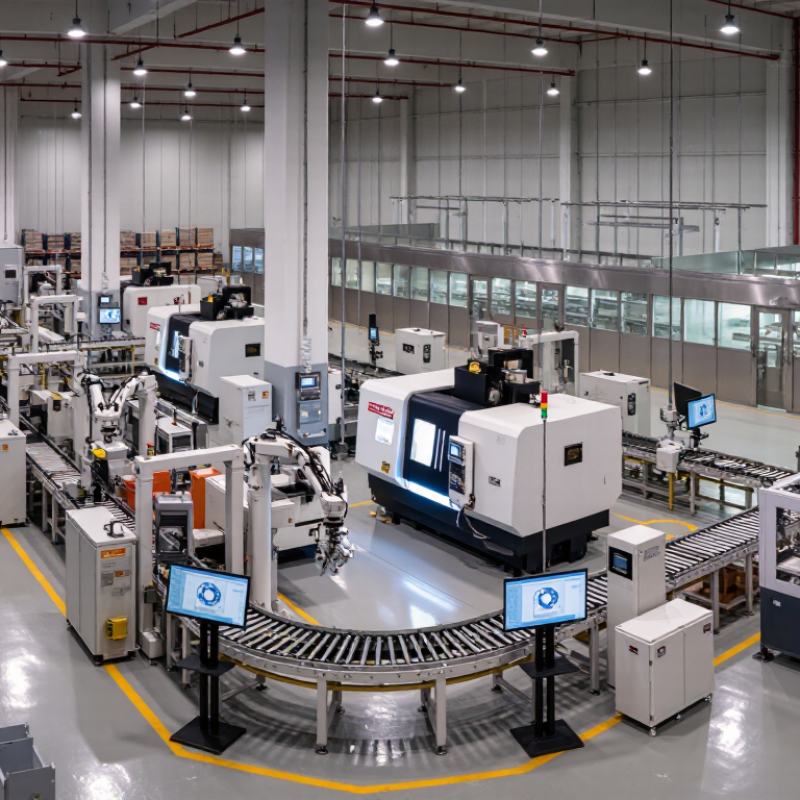
Automation machine manufacturers in China design and build equipment that performs production tasks with limited human intervention. Their work covers robotic cells, assembly lines, packaging systems, inspection equipment, conveyors, and industrial control cabinets. Some companies produce standardized machines. Others engineer custom systems around a client’s product, factory layout, and production speed.
The sector is broad, not a single factory category. Original equipment manufacturers build complete machines, while system integrators connect robots, sensors, software, and safety devices. Component specialists supply motion controls, vision modules, drives, and pneumatic parts.
According to the International Federation of Robotics’ World Robotics 2024 report, China installed 276,288 industrial robots in 2023, representing 51% of global installations.
That figure shows strong demand, but robot purchases alone do not prove reliable automation.
Practical evaluation requires more than catalog specifications. Buyers should inspect factory acceptance tests, cycle-time records, spare-parts plans, software documentation, and technician response times.
A credible manufacturer can explain repeatability under real production conditions. It should also provide risk assessments and compliant machine safeguards.
The China Association of the International Trade Promotion and other industrial studies continue to identify smart manufacturing as a major investment direction. Yet integration quality varies.
Some machines look impressive during demonstrations but struggle with dust, vibration, or frequent product changes. Factory visits and sample testing remain essential.
Small details matter.
Selecting the China Top 10 Automation Machine Manufacturers requires more than comparing product catalogs. A reliable evaluation begins with verified production experience, engineering capability, and documented customer projects. Reviewers should examine factory capacity, quality-control procedures, testing records, and the technical skills of service teams. Site visits can reveal details that brochures often hide, such as machine cleanliness, assembly discipline, and spare-parts storage.
The selection process should use clear scoring criteria. Product accuracy, customization ability, delivery performance, warranty response, and long-term maintenance all deserve measurable weight. Independent certifications and traceable inspection reports strengthen credibility, but they should not decide everything. A certified factory may still provide slow support or inconsistent communication. Customer references should be checked carefully, preferably through recent projects with similar production demands. The method is useful, but never perfect.
Tips: Request sample testing before signing a contract. Ask for a written acceptance standard. Compare actual cycle times, energy use, and operator training plans. Keep communication records. Small details matter.
A strong shortlist also considers financial stability and continuous improvement. Manufacturers that document design changes and corrective actions usually show greater professional maturity. However, rankings can reflect incomplete information, especially when factory data changes quickly. Readers should treat the Top 10 list as a starting point, not a final decision. Personal factory audits and independent technical advice remain valuable.
The top 10 manufacturers are selected using a weighted evaluation framework rather than company-reported rankings. Manufacturing capability and product breadth receive the highest weights, followed by engineering expertise, quality compliance, delivery performance, international project experience, and after-sales support.
China’s top 10 automation machine manufacturers reflect a broad, increasingly specialized market. The International Federation of Robotics reported 276,288 industrial robot installations in China during 2023, representing more than half of global demand. This scale rewards suppliers with reliable service, flexible engineering, and strong component integration.
The leading profiles usually fall into ten capability groups. Some build servo systems, PLCs, and motion controllers for precise assembly. Others produce six-axis robots, SCARA robots, or delta robots for electronics and packaging. Several focus on machine vision, CNC equipment, laser processing, or automated inspection. Additional specialists design warehouse systems, process-control equipment, packaging lines, and complete turnkey production cells. According to the IFR World Robotics 2024 report, China also had the world’s largest operational industrial robot stock, exceeding 1.9 million units in 2023. That installed base creates demand for retrofits, maintenance, and software upgrades.
Factory visits reveal practical differences. One supplier may deliver faster cycle times, while another offers better fault diagnosis through remote monitoring. MTBF figures, spare-part availability, safety certification, and commissioning records deserve close review. The China Association of Robot Industry has also highlighted growing domestic demand for intelligent manufacturing and integrated control systems. Yet rankings remain imperfect. Public revenue data can mix robots, components, and project contracts. A smaller specialist may outperform a larger supplier on a difficult production line, especially when engineers adjust grippers, sensors, and software beside the machine.
China’s leading automation machine manufacturers compete through products, technologies, and application depth. Their portfolios commonly include industrial robots, CNC systems, servo presses, vision inspection equipment, packaging lines, and automated storage systems. According to the International Federation of Robotics’ World Robotics 2024 report, China installed 276,288 industrial robots in 2023, representing 51% of global installations. This demand supports strong engineering capability, especially in automotive, electronics, battery production, logistics, food processing, and medical manufacturing.
Technology choices differ by factory. High-speed assembly lines may combine machine vision, servo motors, programmable controllers, and real-time production monitoring. Welding cells need stable robot paths and precise safety systems. Battery plants require clean handling, traceability, and controlled material movement.
Many suppliers now offer digital twins, predictive maintenance, and autonomous mobile robots. The Ministry of Industry and Information Technology has also identified intelligent manufacturing as a major development direction.
That matters. Yet a polished catalogue does not guarantee reliable integration. Some suppliers provide excellent hardware but weaker software support, documentation, or overseas service. Buyers should test cycle time, accuracy, uptime, spare-part access, and operator training before approval.
The best evaluation is often a factory acceptance test using real components, not a showroom demonstration. Industry data gives useful direction, but site conditions still decide performance.
How to Compare and Choose a Chinese Automation Manufacturer
Choosing among China’s top automation machine manufacturers requires more than comparing quotations. Start with your production data: cycle time, product dimensions, accuracy, material flow, and expected uptime. A reliable manufacturer should convert these details into a clear technical proposal. Ask for layout drawings, control architecture, component lists, and acceptance criteria. Vague promises are warning signs.
Factory verification adds practical confidence. Review similar machines through live video or an approved site visit. Watch the machine run, not just finished demonstrations. Check wiring quality, guarding, noise, changeover time, and operator access. Request references from projects with comparable workloads. Certifications matter, but they do not replace engineering evidence. Confirm whether the supplier can meet your destination’s safety and electrical requirements.
Communication is equally important. Assign one technical contact and record every revision. Require a documented factory acceptance test before shipment. It should measure speed, repeatability, fault recovery, and product quality using your samples. Discuss spare parts, remote support, training, and response times in writing. A low quote can look attractive. It may also exclude installation or software changes. No supplier gets everything right. Even a strong design may need adjustment after production begins. Leave time and budget for that reality. Then compare total operating value, not only the purchase price.
| Profile | Primary Automation Focus | Typical Machine Scope | Customization Capability | Typical Project Lead Time | Production Capacity | Export Readiness | Quality-System Evidence | After-Sales Support | Integration Capability | Best-Fit Buyer | Overall Evaluation |
|---|---|---|---|---|---|---|---|---|---|---|---|
| Profile 01 | Automated assembly lines | Indexing systems, screwdriving, pressing, testing, and traceability stations | High Strong engineering-to-order capability |
12–24 weeks | Medium to high; suitable for multi-station projects | Strong; commonly supports overseas installation and documentation | ISO 9001 evidence should be requested; machine-level validation available | Remote support plus optional on-site commissioning | High PLC, robot, vision, MES, and safety integration |
Automotive, electronics, and precision-component manufacturers | ★★★★☆ |
| Profile 02 | Packaging automation | Cartoning, case packing, labeling, palletizing, and end-of-line systems | High Layout and tooling modifications available |
10–20 weeks | High; standardized modules support repeat orders | Strong; export packaging and electrical adaptation commonly available | ISO 9001 and factory acceptance testing should be confirmed | Spare-parts support and video troubleshooting | High Conveyor, robot, barcode, and line-control integration |
Food, beverage, pharmaceutical, and consumer-goods producers | ★★★★☆ |
| Profile 03 | Robotic handling and palletizing | Pick-and-place cells, depalletizing, palletizing, and material handling | High Cell design based on payload and cycle-time requirements |
8–18 weeks | Medium to high; modular robotic cells | Strong; international safety documentation should be checked | ISO 9001 may be available; request risk assessment and FAT records | Remote diagnostics and installation assistance | High Robots, conveyors, vision, grippers, and safety systems |
Warehousing, logistics, packaging, and heavy-material operations | ★★★★☆ |
| Profile 04 | Machine vision inspection | Dimensional inspection, defect detection, OCR, barcode reading, and sorting | High Inspection algorithms and fixtures tailored to the product |
8–16 weeks | Medium; project-based engineering model | Moderate to strong; software documentation must be reviewed | Quality records and calibration procedures should be requested | Remote software support and operator training | High Vision, PLC, database, reject, and traceability systems |
Electronics, plastics, automotive, and medical-device suppliers | ★★★★☆ |
| Profile 05 | Liquid and powder filling | Filling, capping, sealing, dosing, weighing, and container handling | High Product-contact parts and filling ranges can be configured |
12–22 weeks | Medium to high; standardized filling platforms | Strong; export compliance depends on the target market | Material certificates, cleaning records, and FAT documentation should be verified | Commissioning, maintenance guidance, and spare-parts supply | Medium to high Can integrate conveyors, labeling, inspection, and packaging |
Cosmetics, chemicals, food, beverage, and pharmaceutical operations | ★★★★☆ |
| Profile 06 | CNC loading and unloading | Machine tending, part transfer, deburring, washing, and in-process inspection | High Cell layout and grippers adapted to part geometry |
10–20 weeks | Medium; strong in custom workholding and cell design | Moderate; overseas installation capability should be confirmed | Process capability data and acceptance criteria should be documented | Remote support with optional commissioning services | High CNC, robot, tooling, probing, and safety integration |
Metalworking, automotive components, and precision machining plants | ★★★★☆ |
| Profile 07 | Fastener and small-parts automation | Feeding, orientation, assembly, riveting, pressing, and functional testing | High Feeding systems and tooling are product-specific |
12–24 weeks | Medium; optimized for specialized high-volume applications | Moderate; documentation and field-service coverage require verification | Inspection plans, sample approval, and process records should be requested | Training and remote troubleshooting generally available | High Feeders, servo systems, vision, testing, and traceability |
Hardware, electrical, automotive, and appliance-component producers | ★★★☆☆ |
| Profile 08 | Special-purpose forming machinery | Stamping, bending, forming, cutting, welding, and automated transfer systems | High Engineering depends heavily on material and process parameters |
16–30 weeks | Medium; longer engineering and commissioning cycle | Moderate; electrical standards and safety validation need close review | Request load calculations, weld-quality records, and safety validation | On-site commissioning is strongly recommended | Medium Good mechanical integration; controls scope varies by project |
Metal fabrication, appliance, construction, and industrial-component producers | ★★★☆☆ |
| Profile 09 | Warehouse and intralogistics systems | Conveyors, sortation, storage/retrieval, picking, and warehouse control interfaces | Medium to high System design depends on facility layout and software requirements |
16–32 weeks | High for system projects; hardware and software coordination required | Strong; project management and site installation capability are important | Request software validation, safety assessment, and performance test records | Service-level agreements and local support should be negotiated | High WMS, WCS, barcode, RFID, conveyors, and robots |
Distribution centers, e-commerce, manufacturing, and third-party logistics | ★★★★☆ |
| Profile 10 | Standard modular automation equipment | Standard conveyors, workstations, labeling units, feeders, and compact assembly machines | Medium Fast configuration with limited process-specific redesign |
6–14 weeks | High for repeatable standard equipment | Moderate to strong; export packaging and manuals should be confirmed | Request ISO documentation, component lists, and final inspection records | Online support and replacement-parts service | Medium Suitable for common PLC, sensor, and conveyor interfaces |
Small and medium-sized manufacturers seeking short delivery times | ★★★☆☆ |